Skip to content
conULTRA.Contact us

Software we've built and helped improve.

For many years, we have designed, built and improved digital products across industries, from customer applications and e-commerce to internal tools and connected systems.

New subject matter is part of the work. We learn how your industry operates with the people who know it, then turn that understanding into useful software. SKYFLD and WonderConnect are two examples of that wider experience.

Discuss your project

Selected Work

Agriculture & geospatial software

SKYFLD connected satellite and sensor data with field decisions, tasks and machinery. A long-term client engagement that grew our expertise in agriculture and GIS.

Read the SKYFLD story →

Global eSIM commerce platform

WonderConnect is a global eSIM shop with customer applications, connectivity-provider integrations and the tools for running an international commerce business.

Read the WonderConnect story →

SKYFLD: A Platform For More Sustainable Farming

Satellite, sensor and field data turned into practical decisions.

  • A client engagement of approximately five years.
  • Web, iOS and Android.
  • Europe and South America.

Agriculture and geographic information systems (GIS) were new territory when we began working on SKYFLD. The chance to build something useful for more sustainable farming motivated us to learn. Working with the client and people in the field, we developed practical expertise in precision agriculture and geospatial software.

SKYFLD connected satellite imagery, weather, IoT sensors and field observations with day-to-day agricultural decisions. Our work ranged from farm research to web and mobile development, machinery integrations and technical handover.

Start with the people in the field

Together with the client, we visited farms in Europe and South America. These included highly digital operations and farms with less technology. Understanding both mattered: the platform had to make sense to people with different equipment, working practices and levels of digital experience.

The research covered how farmers worked, how machinery was used and where existing processes created friction. It informed product priorities, interface design, mobile functionality and integration requirements.

The findings helped us decide which information people needed, where it belonged in the interface and which workflows had to work directly in the field.

From Field Data To Field Action
  1. Understand the fieldBring satellite, weather, sensor and field information together.

  2. Decide what needs attentionUse maps and agronomic tools to review conditions.

  3. Plan the workAssign a field task or create a map specifying different application rates across a field.

  4. Carry it outField teams use mobile tools; compatible machinery can use the application maps.

  5. Record what happenedObservations and machine-generated records return to the platform.

From an observation to a field task

Consider a field that needs a closer look. A manager or agronomist could review the available information, create a task and assign it to a worker or scout with the relevant field location attached.

In the field, the worker could use an iOS or Android device to record observations, take photographs and document what they found. That information became available to the wider team, connecting the original question with the activity and its record.

This linked monitoring with work management. Maps were not only something to look at; they provided context for tasks, collaboration and follow-up.

From a treatment plan to machine records

Different parts of a field can require different application rates. SKYFLD supported maps for variable-rate seeding, fertilisation and plant growth regulators, allowing planning to reflect those differences rather than treating the whole field uniformly.

We worked with John Deere Operations Center APIs to connect SKYFLD with compatible machinery workflows, including application-map transfer. Machine-generated records could also be imported into SKYFLD, showing what was actually applied alongside what had been planned.

Agronomic tools, including a nitrogen calculator, supported planning as well as monitoring. The product linked agricultural planning with field work, rather than leaving the result as a map on a screen.

IoT integrations brought sensor measurements, such as soil moisture, into the same field context as satellite imagery and weather. Farmers could review the information together rather than switch between disconnected tools.

Engineering behind the maps

The visible simplicity depended on work across frontend, backend and integrations.

  • Interactive maps: Large numbers of field polygons and data overlays had to remain responsive while calculations and generated information changed.
  • Different sources, one working context: Satellite information, weather, field boundaries, IoT sensors and machinery systems used different formats, authentication methods and update frequencies. Backend and integration work brought that information into the product.
  • Privacy and access: Architecture, permissions and data handling were developed with privacy in mind, including the sensitivity of agricultural business information.

These were connected product decisions: map performance, data processing and interface design all affected whether the information was useful to someone working with it.

Built for an international business

The agricultural workflows were only part of making the product usable as a business. We also worked on payments, subscriptions, user management, customer-support infrastructure and connections to regional CRM environments.

Localisation covered interfaces, product terminology and help content across web and mobile. Work with regional teams connected the platform to existing sales and customer-management processes in Europe and South America.

White-label capabilities allowed the underlying platform to serve additional brands. These elements supported a reusable product with shared commercial and operational infrastructure.

Documentation and handover

Our contribution included project management, elements of product ownership and consulting, UX/UI design, frontend, backend and mobile development. We worked with client stakeholders, regional teams and external technology partners as the product developed.

The engagement concluded with technical documentation and knowledge transfer so the client's organisation could continue development internally. Documentation covered architecture, components, APIs, integrations and technical processes.

Our involvement ended with that handover; SKYFLD is not a product we continue to operate.

See how we organise project delivery.

Discuss a similar project

WonderConnect: Global eSIM Shop

Connectivity is technical.Using it should not feel technical.

Web, iOS and Android. Custom-built from the ground up for a global market.

  • Over 4,000data plans
  • 200+destinations
  • 12languages
  • 19currencies
  • 500+mobile networks across the catalogue
  • 500+phone models in the compatibility catalogue

We knew the problem from our own travels. Getting mobile data abroad meant working through unfamiliar offers, device requirements and installation instructions, often when a connection was needed most. The technology was available; making it understandable was another matter.

WonderConnect grew from that experience. We designed the customer journey, commerce, provider integrations and internal tools around the needs of an international eSIM business. They work together as one platform, while customers see a straightforward way to get connected.

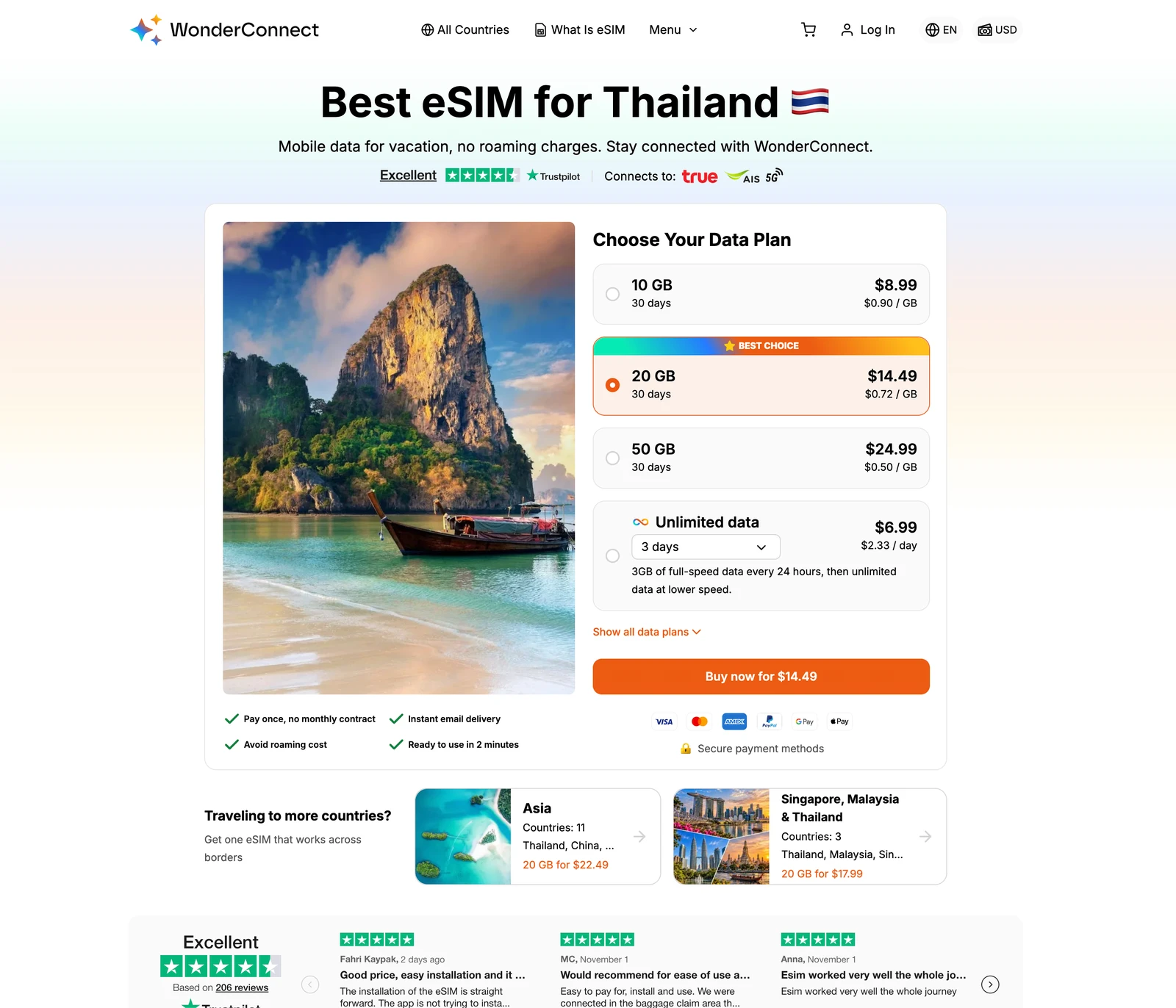
WonderConnect product screen helping a traveller select a suitable mobile data plan.
WonderConnect / Customer experience

A simpler customer journey

The journey is deliberately simple: choose a plan, buy it, install the eSIM and connect. But each step raises practical questions. Does my phone support eSIM? How much data will I need? When does the package activate?

We built a compatible-device catalogue, a data calculator and guided onboarding to address those questions in context. The catalogue also explains regional variants and carrier-lock restrictions. Customers can use familiar activities, such as navigation or video calls, to estimate their needs instead of having to interpret a data allowance on its own.

Web, iOS and Android connect to the same platform. Account information, package status, installation guidance and compatible top-ups remain part of the service after checkout.

One platform behind the purchase

Different connectivity providers have different APIs, product structures and activation rules. A purchase therefore needs more than a checkout: the right eSIM must be provisioned, delivered and managed throughout its lifecycle.

We built a provider-independent layer that brings those differences into one platform. The catalogue, payments and connectivity processes work together behind a consistent customer experience. The architecture supports adding providers and destinations within that shared system.

Tools for the people running the business

Support, operations and commercial teams need to work with the same product and order information. Internal tools bring catalogue management, pricing, eSIM status, orders and partner activity together.

Routine catalogue and price changes do not need to become engineering tasks. Support teams can work with the information relevant to a customer's situation, while dashboards bring sales, product and acquisition information together for commercial decisions.

The work therefore extends beyond what travellers see. It includes the software that makes the service manageable for the people responsible for it.

Commerce beyond the storefront

An international commerce business needs ways to reach customers as well as serve them. We built affiliate and referral infrastructure with tracking and attribution, linking partner referrals with attributed orders.

Automated product feeds make catalogue information available to Google Merchant Center and price-comparison platforms. This connects acquisition channels to the central product data instead of relying on separate manual updates.

The platform also supports wholesale ordering and white-label distribution. These extend the same underlying technology beyond direct consumer sales, with partner operations connected to the core platform.

AI in the customer experience

Connectivity questions often arise during a trip. AI-assisted support works with a structured knowledge base to answer common product, installation and troubleshooting questions. Human support remains available when the situation needs personal attention.

AI-assisted workflows and central translation tooling helped us roll out 12 languages quickly across the website, iOS and Android apps, emails and push notifications. Product terminology and native-speaker validation kept the language consistent and understandable across those touchpoints.

Explore how we apply AI.

Learning from daily operations

Running WonderConnect gives us direct feedback after release. Support conversations, customer behaviour and operational information show where explanations, product decisions or internal workflows need attention.

WonderConnect is a conULTRA venture that we continue to develop and operate. That gives client work a practical perspective shaped by customer questions, commercial decisions and maintenance after launch.

See how we measure and improve.

Inside the connectivity platform

The engineering work connects the customer journey with the state of the service behind it.

  1. International commerceProduct catalogues, currencies, payments and localised content connect to customer-facing web and mobile products.
  2. Payment riskPayment processing is supported by fraud-prevention and risk-management capabilities.
  3. eSIM lifecycleProvisioning, installation, activation, usage, compatible top-ups and expiry need a consistent representation across providers.
  4. Connected operationsOrder processing, product feeds, customer communication and partner attribution are supported by shared systems and automation.
Discuss a similar project